
In this article we will look at whether lipedema really does appear in childhood, which signs distinguish it from ordinary growth, and what is worth doing when a suspicion arises at an age when the body is changing anyway.
Can children develop lipedema?
The answer is yes, but it is a very rare phenomenon, documented so far in only a small number of cases.
Lipedema is a chronic disorder of fat tissue, characterised by an accumulation of fat in particular areas and often accompanied by pain, tenderness to touch and a nodular texture beneath the skin.
The full background on the condition is gathered in the article what lipedema is.
A comprehensive review published by the American Lipedema Foundation in 2023 includes reports of children who developed lipedema before the age of 10.
The review makes clear, though, that there is no separate form of the condition called "childhood lipedema", and that this is the same condition appearing earlier than usual.
What is known about these cases rests on isolated documented reports rather than on organised research.
One detail in the review concerns parents in particular: in every case where symptoms began before the age of 10, lipedema was found to be present in the family as well.
The researchers explain that the hormonal shift of puberty may set the condition off, but is not a necessary condition for its appearance.
It follows that where a mother, grandmother or sister has lipedema, and the child too has painful legs disproportionate to the rest of the body, the suspicion is worth taking seriously.
Why does it begin at puberty in particular?
For most people with lipedema the first signs appear around puberty. Studies differ as to the exact proportion and report a wide range, between 15.7% and 67.3% of patients.
Even so, in every one of these studies puberty emerges as the most common stage for the condition to appear, whatever the precise figure.
The accepted explanation is that lipedema fat tissue tends to respond to hormonal changes, and to oestrogen in particular. We have written at length about that connection across the lifespan in the article the effect of hormones on lipedema.
It is worth knowing that this remains an explanation rather than proof, since no primary study has yet shown that sex hormones are what cause the condition to develop.
In practical terms, puberty is the period in which a change in body shape is worth paying attention to. There is no reason for alarm, but there is also no need to dismiss every change as simply being puberty.
How is lipedema distinguished from ordinary growth?
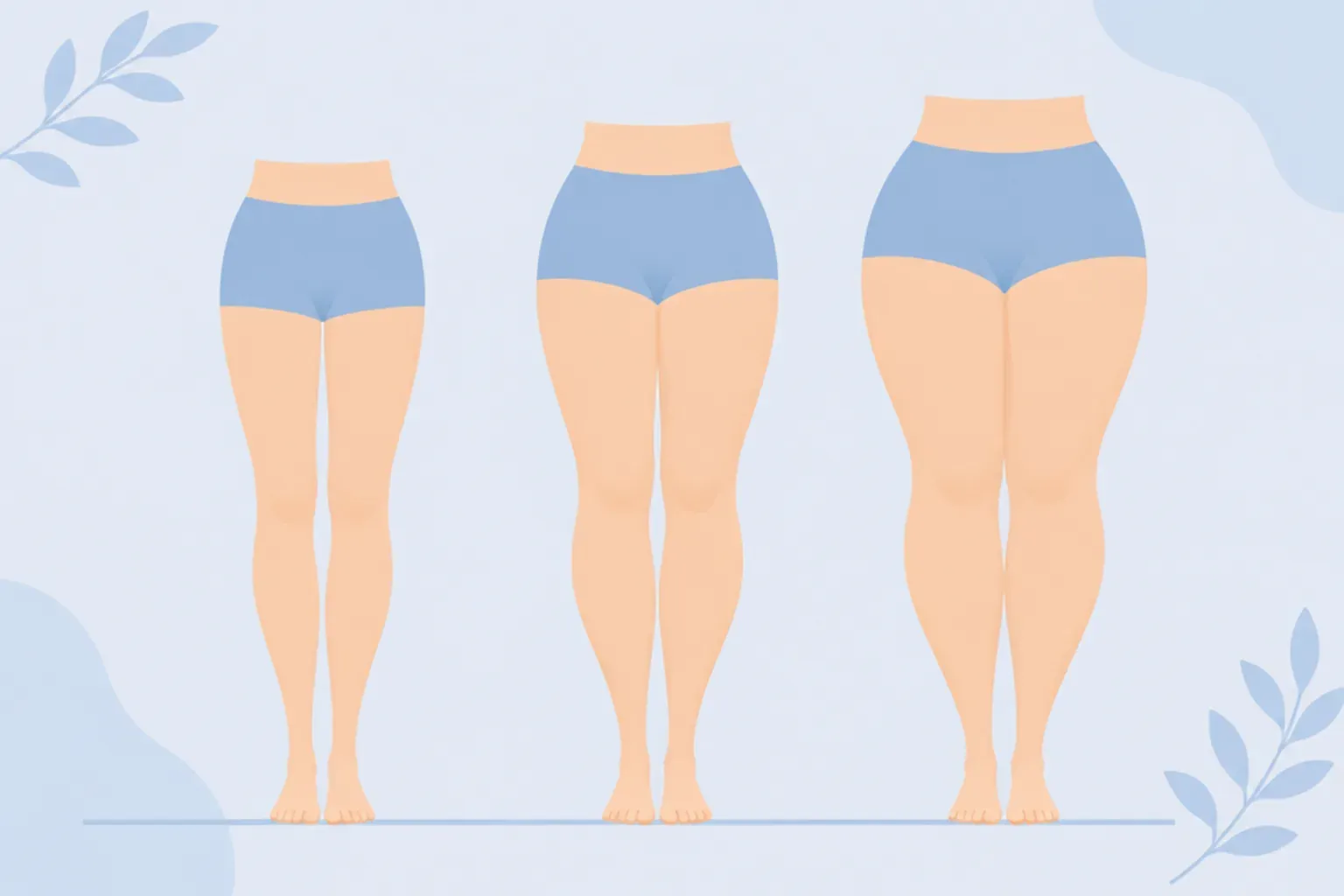
During puberty the body changes quickly, and changes that look dramatic are usually normal. What distinguishes ordinary growth from lipedema is not the size itself, but the combination of several signs appearing together.
In 2024 a comprehensive medical guideline on lipedema was published in Germany, defining the condition as a symmetrical and disproportionate accumulation of fat in the limbs, accompanied by pain.
The pain is not a side effect but part of the definition itself. According to the guideline, pain on pressure, tenderness to touch, pain that appears on its own and a sensation of heaviness are all regarded as symptoms of the condition.
Among the signs worth paying attention to:
- The legs thicken, while the upper body remains relatively slim.
- Both legs are affected to the same degree.
- Pain or tenderness appears in the area, at times even without unusual exertion.
- Minor knocks tend to leave bruises.
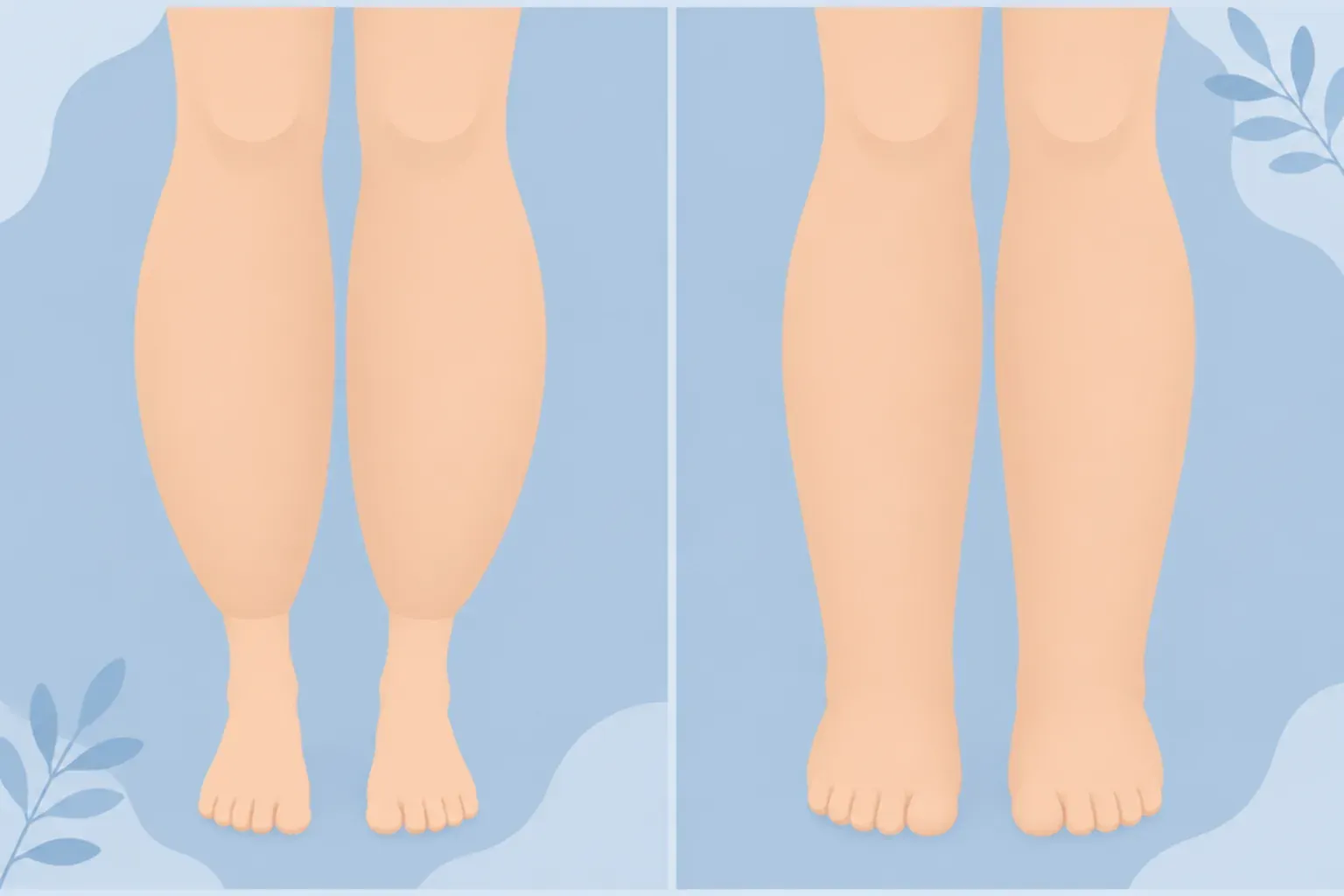
- The feet remain unchanged, creating a kind of step above the ankle.
- A nodular texture resembling small grains can at times be felt beneath the skin.
No single sign is sufficient on its own, and the diagnosis is made by a doctor from what they see and feel, since no blood test or imaging study can prove lipedema, and these are used mainly to rule other conditions out.
A fuller account of the differences between the conditions that are confused with one another appears in the article lipedema or something else?.
And anyone who believes that a slim child cannot have lipedema will find an answer in the article why some thin women have lipedema.
What else can cause large legs in a child?
Enlargement of the legs at a young age may stem from medical conditions that differ greatly from one another, and some of them require a more urgent workup than lipedema.
At a children's hospital in the United States, children referred to the clinic for enlargement of the legs were examined.
In about a quarter of them the diagnosis they arrived with was not confirmed, and the enlargement turned out to stem from an entirely different condition.
Among the conditions found: vascular malformations, overgrowth of one side of the body, swelling following an injury, and in 6.5% of the children lipedema.
The conclusion runs two ways. On one hand, lipedema in children does reach clinics, and it may be hidden behind another diagnosis.
On the other hand, large legs in a child are a sign that justifies examination by a doctor rather than a search online, since some of the conditions described here require a far faster workup than lipedema does.
If sudden pain, redness or local heat appear, a doctor should be seen without delay.
Who should be approached in Israel?
The first stop is not a dedicated clinic but routine monitoring. Children in grades 1 to 9 receive health services under the National Health Insurance Law, continuing the preventive service provided at well-baby clinics.
These services include growth checks among other things, and this is therefore a natural opportunity to raise the question, even though it is not an examination that looks for lipedema.
From there the route runs through the paediatrician, who can refer the child to a specialist.
With regard to compression stockings, one detail is worth knowing in advance. As of November 2026, the health funds cover them on the basis of a lymphatic diagnosis and with a valid referral from a vascular surgeon or a lymphatic physiotherapist.
At Maccabi, for example, the fund covers 60% of the cost under the basic plan, and the quantity is set in the referral.
Lipedema in itself is not a qualifying diagnosis, and it is therefore better to clarify what is required with the fund before making the purchase.
What can be done at a young age?
Even when there is as yet no definite diagnosis, the approach recommended at a young age closely resembles the one recommended at any age, and it is unlikely to cause harm.
One point should be made clear: there is no treatment today that cures lipedema, and none of the tools below dissolves the fat tissue. They may, however, reduce pain, swelling and a sensation of heaviness, and help preserve movement.
Among the accepted tools:
- Regular physical activity adapted to the child's capacity. The article training that helps and training that hurts explains what tends to help and what helps less.
- Compression stockings where needed. The German guideline stresses that they are intended to ease pain rather than to reduce fat tissue.
- Anti-inflammatory nutrition as part of a way of living, and not as a weight-loss diet.
With regard to the stockings, the guideline recommends choosing the lowest compression level that provides relief, so that the child will actually wear them.
Liposuction is regarded as the accepted surgical procedure for adults with lipedema. That same guideline nevertheless states unanimously that in patients under the age of 18 it should be weighed with particular caution.
It further determined that surgery should not be decided upon according to the stage of the condition, since symptom severity does not necessarily go hand in hand with the stage.
The staging system itself is described in the article the differences between the stages of lipedema.

How should this be discussed with a child or adolescent?
The psychological aspect is not secondary at this age, and the German guideline notes that people with lipedema may experience a psychological burden heavier than the physical one.
A qualitative study conducted in Norway in 2023 interviewed fifteen women with lipedema aged 21 to 47. The younger participants described greater difficulty at the stage of receiving the diagnosis, a sense that professionals did not believe them, and damage to their self-confidence.
The study did not examine adolescents, so no direct conclusions about children can be drawn from it. Even so, it indicates that a young age offers no protection from the psychological aspect.
Two things follow from this. The first is avoiding any presentation of the situation as obesity, and avoiding turning weight loss into the child's task, since such a framing may create guilt without changing the tissue.
The second is that there is also a reassuring message here with a basis in the guidelines: lipedema should not be seen as a condition that worsens by itself in everyone, and its progression depends on various factors.
We have written at length about the effect of psychological stress on symptoms in the article lipedema and stress.
What is still unknown?
Existing knowledge about lipedema in children is very limited. There is no medical guideline written specifically for children, and all the existing guidelines relate to adults.
Nor are there figures saying how many children live with the condition, and even the German guideline notes that no epidemiological studies meeting today's diagnostic criteria exist.
What is known is that early onset exists and is documented, and that symptoms can begin to be eased even before there is an unambiguous diagnosis.
A parent who notices two legs thickening to the same degree, painful or tender to touch, and who knows that lipedema is present in the family, is not overreacting by asking for a workup.
This is precisely the stage at which early recognition may save years of explanations that never fitted.
Sources
- Lipedema: A Current Understanding of its Pathology and Natural History (Lipedema Foundation, 2023)
- S2k guideline lipedema (AWMF 037-012, גרסה אנגלית מלאה, 2024)
- S2k guideline lipedema — JDDG 2024 (PubMed)
- Differential diagnosis of lower extremity enlargement in pediatric patients referred with a diagnosis of lymphedema (Plast Reconstr Surg, 2011)
- Younger Women with Lipedema, Their Experiences with Healthcare Providers, and the Importance of Social Support and Belonging (IJERPH, 2023)
- Lipedema Foundation — מידע למטופלים
- מכבי — חבישות לחץ לחולים לימפתיים, תנאי הזכאות
- כל־זכות — בדיקות שיגרה לתלמידי בית ספר
- איך נכתבה הכתבה הזו
- ההצהרה הרפואית המלאה
Reader feedback
Did you find this article interesting?
Share



Comments
0 comments |Read and add your own comment
No comments yet - be the first.