
The full background on the condition is gathered in the article what lipedema is.
In this article we will look at what exactly happens to the body on entering the water, what the research actually shows for lipedema, which temperature is considered suitable, and why this last point deserves particular attention in Israel.
What happens to the body on entering the water?
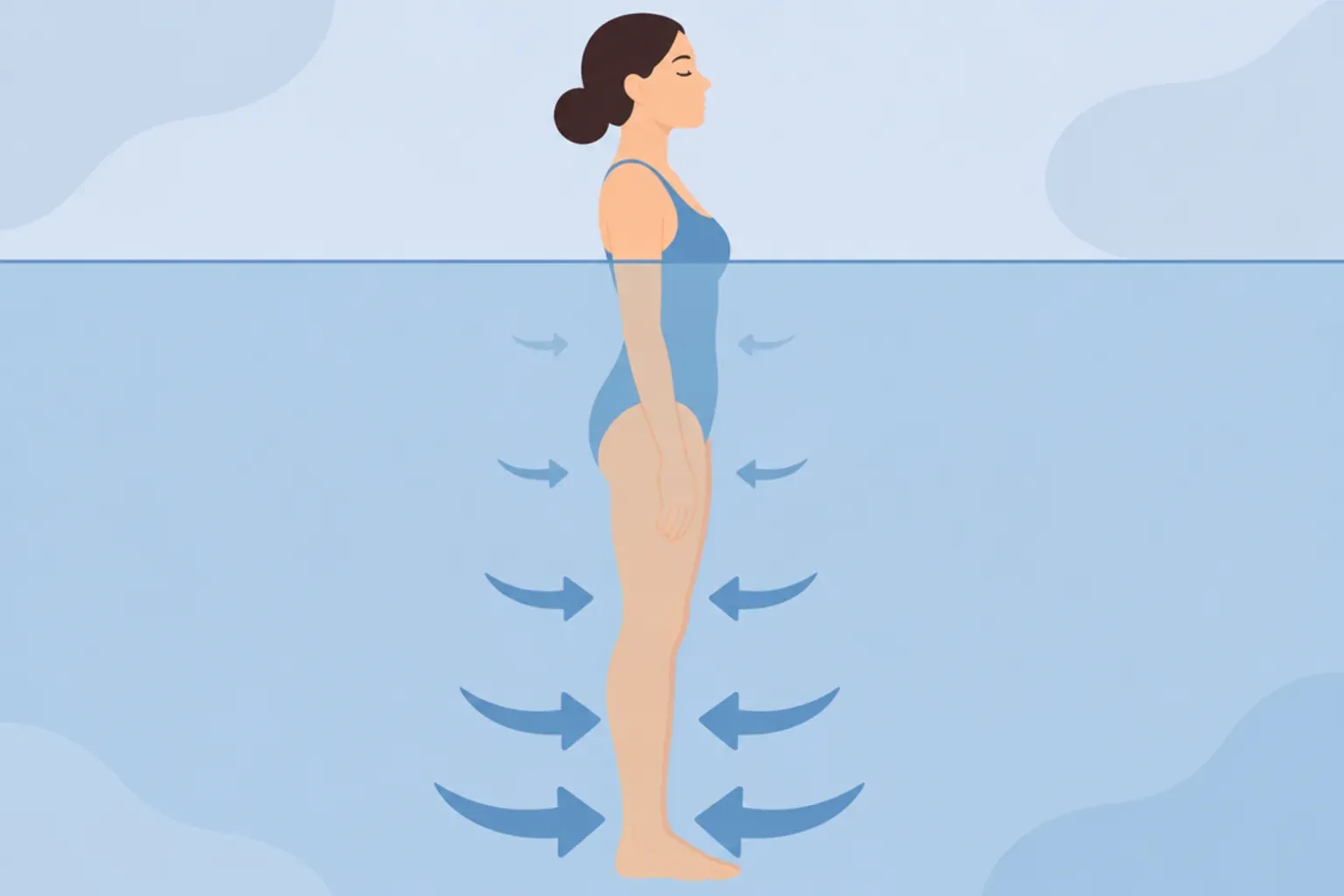
When the body is immersed, hydrostatic pressure acts upon it, meaning the pressure the water exerts on the whole submerged surface, and it increases the deeper one goes.
This means that the pressure on the feet and lower legs is higher than the pressure acting on the thighs or the abdomen, and it amounts in effect to a pressure gradient rising from below upwards, precisely the principle on which compression stockings are based.
The accepted view is that this gradient may help push fluid from the tissues back into the blood and lymphatic circulation.
This is the explanation generally given in the literature for the effect of immersion on swelling in the limbs, although it remains a mechanistic explanation rather than a directly measured finding.
A second thing happens at the same time: buoyancy removes a considerable part of the weight the legs carry, and so it is usually possible to keep moving for longer without the load that accompanies activity on land.
This is also why movement in water is considered a convenient option for anyone affected by prolonged sitting during the day. The mechanism by which muscle activity may support lymphatic flow is described in the article on the lymphatic system.
Does swimming really reduce swelling?
A distinction has to be drawn here between the theoretical explanation and what has actually been measured, because direct research on lipedema is still very small.
The few studies that examined water-based exercise in people with lipedema dealt mainly with aqua cycling, and the groups were very small, at times only five participants in each study arm.
The results are not uniform. Some participants reported a reduction in pain and an improvement in quality of life, but the effect on leg circumference itself was not consistent.
This distinction matters, because it recurs in almost every piece of work in the field: how a person feels tends to improve more readily than what the tape measure shows.
Anyone expecting to see a change in circumference may be disappointed even when the pain has eased.
It is worth remembering alongside this that lymphatic drainage, which is considered the more established treatment, has also been examined only in small studies and yields results of a similar character.
The precise formulation, then, is that water does not dissolve lipedema fat tissue and does not cure the condition, but it may ease pain, the sensation of heaviness and daily functioning.
A larger study, comparing water-based with land-based exercise among sixty women with lipedema, is currently recruiting participants. Its results may change the picture.
What is the difference between swimming and exercising in water?
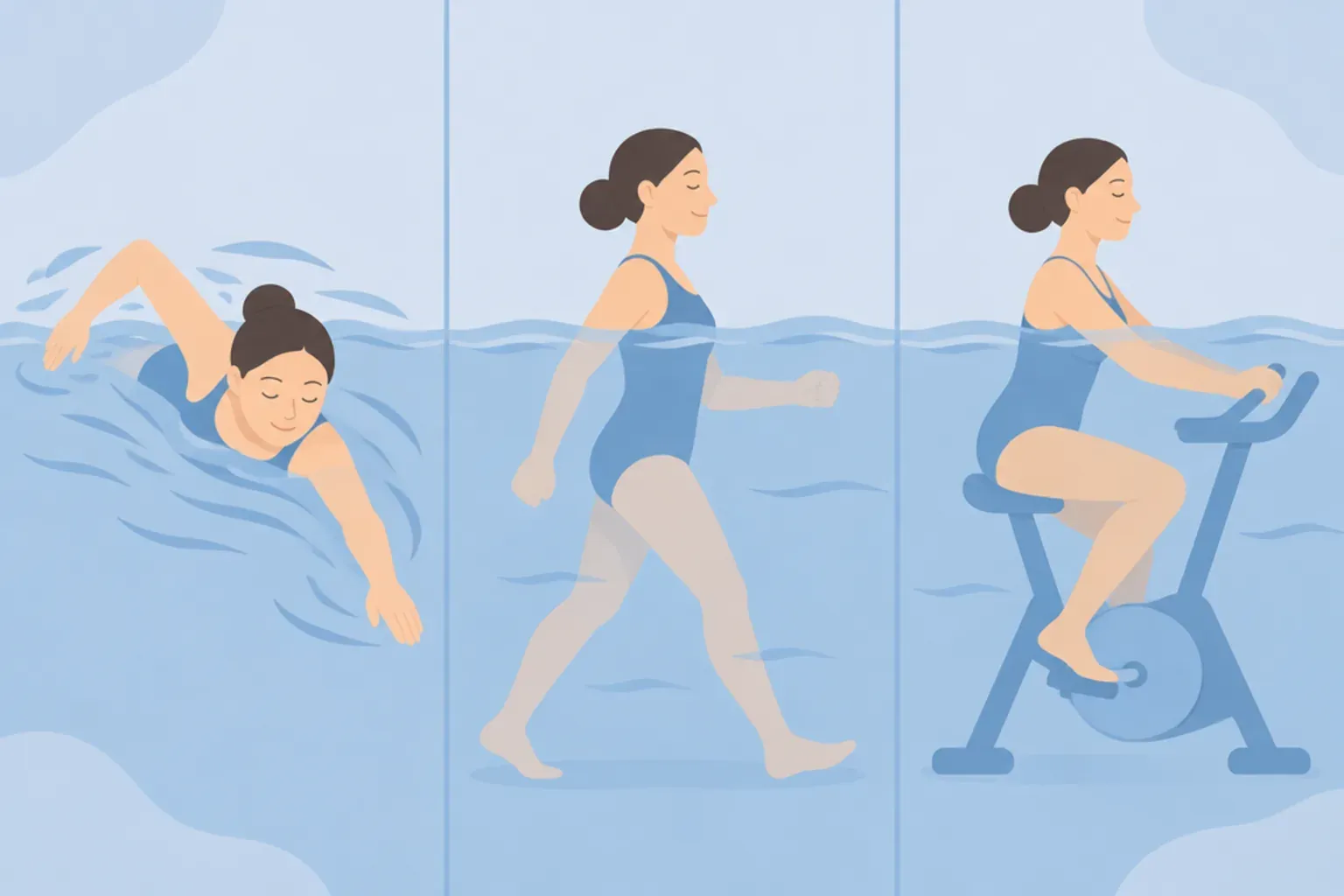
Swimming is only one of the options the water offers, and it is not necessarily the most suitable one for everybody.
Swimming
Swimming is considered an activity that works the whole body and allows continuous aerobic exercise with almost no impact. It does, however, require reasonable technique and comfort in water, and so it is not necessarily a convenient starting point for everyone.
Walking in water
Walking in water at waist to chest depth is considered one of the simplest ways to begin, since it requires no particular skill, and the depth is what determines the strength of the hydrostatic pressure.
Aqua cycling and resistance exercises
These are the options that have actually been examined in studies on lipedema, and they allow controlled work of the leg muscles in the water, usually under professional supervision.
In the study currently under way the immersion depth is individually adjusted for each participant, within a range between the lower tip of the breastbone and shoulder height.
This is a practical detail worth remembering: the deeper the immersion, the higher the pressure on the legs.
Which water temperature is suitable?
Temperature is probably the most important detail in this article, and it is also the one that tends to be forgotten.
Heat may dilate blood vessels and increase the leakage of fluid into the tissues, and many people with lipedema therefore report worsening swelling and heaviness after exposure to heat.
We have written at length about this in the article hot shower or cold? which is better for lipedema.
In the current study on water-based exercise in lipedema the pool is maintained at a temperature of 28 to 30 degrees. This is the only figure available today from research carried out on lipedema itself.
In other words, the research range leans towards water that is pleasant but not hot, and an ordinary public swimming pool usually sits within that range or slightly below it.
Why might therapy pools in Israel be too warm?
There is a local point here worth knowing before signing up for a course of treatment.
Hydrotherapy pools in Israel are deliberately heated to a high temperature, because they are intended mainly for orthopaedic and neurological rehabilitation, where warmth helps muscles relax.
At the therapy pool of Soroka Medical Center, for example, treatments are carried out at a temperature of 33 to 35 degrees.
That temperature is several degrees higher than the range examined in the study on lipedema. This does not mean that hydrotherapy is unsuitable, but it is worth checking the pool temperature in advance and noting how the body responds after the first session.
As of November 2026, hydrotherapy treatments are provided subject to approval from the insuring health fund and on presentation of a medical referral. Here too it is worth clarifying the conditions in advance.
How do you start without making things worse?
The guiding principle is a moderate start and observation of how the body responds over time, rather than comparison with a capacity one had in the past.
- It is worth starting with walking in water or light swimming, on the order of twenty minutes.
- Choose a depth that reaches at least chest level, in order to make use of the hydrostatic pressure.
- It is preferable to choose pleasant rather than hot water, and to avoid a jacuzzi or sauna close to the session.
- It is worth drinking during activity in water too, since thirst is less noticeable there. The article on drinking water deals with this.
- It is worth checking how things feel the next day and not only immediately afterwards. Heaviness or swelling that persists into the following day may justify reducing the intensity.
Anyone weighing swimming against other kinds of activity will find a broader comparison in the article training that helps and training that hurts. Combining movement in water with leg elevation at the end of the day is a routine many find comfortable.
If sharp pain, redness or local heat appear in the leg, a doctor should be consulted and the session should not be continued.
What is still unknown?
The gap between the physiological logic and the direct evidence is particularly wide on this subject.
Hydrostatic pressure is a proven physical phenomenon, but the question of how much it actually contributes for a person with lipedema has not yet been examined in a large study.
The practical questions also remain open. There are no data at present that make it possible to say what the optimal training frequency is, how long it is worth staying in the water, or which precise temperature is preferable in lipedema.
What can be said is that water-based exercise is considered relatively safe, that it reduces the load on the joints, and that reports of pain relief recur even when limb volume does not change.
For someone who struggles with activity on land, this is often the most comfortable entry point into regular movement.
Sources
- Effects of aqua cycling as exercise therapy for lipoedema (Phlebologie / Thieme, 2019)
- Aquatic Versus Land-Based Exercise in Women With Lipedema (ClinicalTrials.gov NCT07756463)
- S2k guideline lipedema (AWMF 037-012, 2024)
- Lipedema: A Current Understanding of its Pathology and Natural History (Lipedema Foundation, 2023)
- Lipedema Foundation — מידע למטופלים
- בריכה טיפולית - הידרותרפיה, המרכז הרפואי סורוקה
- איך נכתבה הכתבה הזו
- ההצהרה הרפואית המלאה
Reader feedback
Did you find this article interesting?
Share

Comments
0 comments |Read and add your own comment
No comments yet - be the first.